Views: 0 Author: Site Editor Publish Time: 2026-06-21 Origin: Site
Electrical and mechanical component design often forces engineers into a difficult choice. Pure copper offers exceptional electrical conductivity and thermal transfer. However, it lacks vital mechanical strength and deforms under pressure. Using pure copper also significantly drives up material expenses. Meanwhile, brass provides excellent durability, stiffness, and machinability. Unfortunately, brass severely compromises electrical performance and heat dissipation. Engineers face constant pressure to balance these extremes.
Enter brass-copper clad metals. This engineered compromise acts as a highly specialized, metallurgically bonded composite. It delivers localized performance precisely where you need it most. By fusing these two metals together, you eliminate the microscopic voids common in mechanically joined parts. You also prevent the severe galvanic corrosion risks associated with traditional plating.
This article provides procurement managers and design engineers with an objective framework. We will evaluate brass-copper composites specifically for precision manufacturing. You will examine material configurations, stamping behaviors, and real-world applications. You will learn how to optimize component reliability without over-specifying raw materials.
Brass-copper clad metals combine the electrical/thermal superiority of copper with the mechanical stiffness and machinability of brass.
Advanced configurations, such as onlay and edgelay profiles, drastically reduce raw material costs by placing high-value metals only at the contact points.
Adopting these materials requires specific adjustments in tooling for precision stamping, but yields superior lifecycle performance for high-cycle components like microswitches.
Evaluating this material involves analyzing the trade-offs between bond strength and formability.
Solid alloys force engineers into a difficult corner during product development. Using monolithic copper for complex electromechanical parts wastes valuable resources. It over-specifies the component where high conductivity remains completely unnecessary. Monolithic copper also deforms easily under continuous mechanical stress. It simply lacks the yield strength for structural integrity.
Solid brass poses its own severe operational risks. It risks catastrophic overheating under high electrical loads. Relying on a single solid metal means you compromise somewhere. You either sacrifice structural integrity or electrical efficiency. You cannot optimize both variables simultaneously.
Cladding fundamentally changes this engineering dynamic. Through advanced metallurgical bonding, manufacturers fuse brass and copper at the atomic level. They achieve this using cold roll bonding or continuous thermal cladding processes. Extreme rolling pressure forces the electron clouds of both metals to share grain boundaries. This method creates a seamless, continuous composite strip.
This permanent bond prevents the microscopic voids frequently seen in mechanical joining. It entirely eliminates the galvanic corrosion risks that plague riveted or bolted assemblies. You get a single, unified strip reacting as one solid material. It behaves predictably under thermal and mechanical loads.
Replacing solid copper with a brass-backed clad material optimizes your material allocation. You deploy the vital copper only at the functional contact points. The brass substrate handles all structural and mechanical loads securely. This targeted approach maintains high performance exactly where current flows. It significantly reduces the volume of conductive metal required across the entire fabricated part.
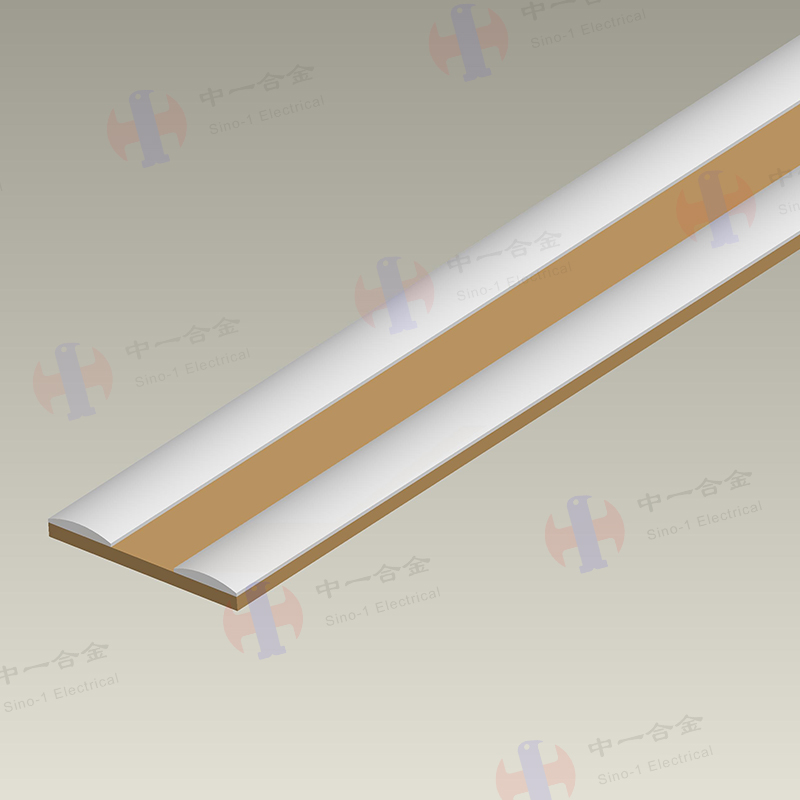
Engineers specify a high bond onlay clad metal strip when conductivity must remain hyper-localized. Onlay cladding bonds a continuous stripe of an active metal directly onto a brass substrate. The active metal—usually highly pure copper—sits prominently on the surface. It remains ready to interface with moving mechanical parts or electrical nodes.
This profile delivers high conductivity exactly at the mating surface. You avoid plating or coating the entire part unnecessarily. Surface plating often wears off rapidly under sliding friction. Cladding provides a solid, thick, and permanent layer of copper. This configuration significantly lowers the total volume of expensive copper needed per component. It offers exceptional electrical transfer dynamics. Simultaneously, the brass backing provides rigid, reliable structural support.
Edgelay cladding positions the secondary metal strictly along the extreme edge of the base strip. We use a wear resistant edgelay clad metal strip for components facing harsh physical environments. The metallurgical bond runs deep into the edge, preventing separation under shear stress.
This specific setup proves ideal for parts experiencing high insertion forces. Sliding friction generates micro-welds that destroy weak platings. The brass base supplies the necessary spring-force and elasticity to absorb impact. The copper edge provides a highly conductive and durable contact zone. This dual-action performance prevents premature wear in friction-heavy applications. Plug-in connectors and sliding wiper contacts rely heavily on this precise configuration.
Summary Chart: Cladding Configuration Profiles | |||
Configuration Type | Placement of Copper | Primary Mechanical Benefit | Ideal Application Scenario |
|---|---|---|---|
Onlay Cladding | Surface stripe (top or bottom) | Thick, wear-resistant contact patch | Relays and microswitches |
Edgelay Cladding | Along the extreme strip edge | High shear resistance during insertion | Sliding contacts and terminal pins |
A dual-metal composite behaves uniquely under intense mechanical stress. The brass base provides essential structural rigidity. It offers excellent springback control during forming, bending, and punching. Copper inherently adds deep ductility and malleability. Together, they create a highly balanced yield strength profile. You must calculate bend radii carefully during tool design. The softer copper layer flows differently than the harder brass layer during plastic deformation.
Producing precision clad metal stamping parts requires strict tooling adjustments. You must engineer your die clearances based entirely on the harder of the two materials. In this scenario, the brass substrate dictates the clearance metrics. Cutting angles must also reflect the brass layer's specific shear properties.
If you base tooling clearances on the softer copper layer, you risk severe edge burring. You also risk smearing the copper across the exposed bimetal interface. This physical smearing can improperly bridge the two distinct metal layers. It frequently causes disastrous short circuits in miniature electromechanical assemblies.
Procurement teams must face reality regarding stamping scrap recovery. Mixed-metal stamping scrap retains distinct value, but differently than pure scrap. Bimetal offcuts command a distinctly lower recycling premium than pure single-metal scrap. Recyclers typically categorize it as mixed alloy scrap. They must use chemical separation processes to recover the elements. You must calculate this lower scrap return rate into your upfront material efficiency models.
Calculate primary die clearance based strictly on the brass substrate to ensure clean shearing.
Apply targeted evaporation lubricants to prevent the softer copper from adhering to the punch.
Design forming bend radii to accommodate the strict tensile limits of the copper inlay.
Monitor all cutting edges frequently, as bimetal transitions accelerate standard tool wear.
Modern microswitches demand extreme reliability under harsh operational conditions. They require phenomenal fatigue resistance to survive millions of rapid actuation cycles. Smart home thermostats and industrial controllers rely on these tiny components daily. They also need exceptionally low contact resistance to prevent signal degradation.
Using a microswitch clad strip elegantly solves this dual engineering requirement. The brass substrate provides the exact necessary spring memory. It ensures structural integrity over countless on-off mechanical cycles. The highly localized copper inlay ensures robust arc resistance during current breaks. It guarantees reliable electrical signal transmission exactly at the contact node. This prevents early device failure.
Automotive powertrains and heavy industrial environments involve extreme vibration. They also produce severe thermal stress cycles. Pure copper terminals often suffer from thermal relaxation under these hostile conditions. They gradually lose their physical grip and degrade the electrical connection. This leads to dangerous power faults.
Brass-copper composites actively prevent this thermal relaxation phenomenon. The brass layer maintains the vital mechanical clamping force around the mating pin. It resists expanding permanently under heat. The copper lining ensures critical electrical pathways remain completely unobstructed. This powerful synergy keeps complex systems operational even inside high-temperature engine compartments.
Material Property Evaluation Table | |||
Property Evaluated | Pure Copper (C11000) | Pure Brass (C26000) | Brass-Copper Clad Composite |
|---|---|---|---|
Electrical Conductivity (IACS) | ~100% | ~28% | Variable (100% at contact zone) |
Tensile Strength (MPa) | Low (approx. 220) | High (approx. 430) | High (Dominated by Brass Base) |
Springback Control | Poor | Excellent | Excellent |
Thermal Relaxation Resistance | Low | High | High |
Purchasing low-quality clad metals poses a massive systemic risk to your production line. Delamination during aggressive forming instantly destroys component viability. You should explicitly require comprehensive testing data from your chosen material supplier. Visual inspections alone cannot detect poor metallurgical bonding.
Demand certified results for severe bend tests and extreme thermal shock tests. These physical metrics verify the actual structural integrity of the high bond claim. Only intensive physical stress testing reveals sub-surface bonding failures. Ultrasonic testing can also identify microscopic voids before the coil enters your stamping press.
Custom clad profiles permanently change your standard supply chain dynamics. They often require higher Minimum Order Quantities (MOQs) than off-the-shelf monolithic alloys. Lead times can stretch significantly longer due to the highly specialized cladding processes. You must plan your inventory models meticulously to absorb these longer procurement cycles.
Use a clear, objective evaluation framework when auditing new bimetal material suppliers. Follow this shortlisting logic strictly:
Verify the exact alloy grades used for both the base substrate and the clad layers.
Request comprehensive temper and hardness data for the finished bimetal composite.
Audit the supplier's edge-slitting tolerances to ensure they match your precise die clearances.
Review historical peel strength test results from their recent production batches.
Brass-copper clad metals do not act as a universal replacement for all solid metals. They represent a highly specific, highly effective engineering solution. They excel in high-volume applications demanding dual requirements of rigid mechanical stiffness and pure electrical conductivity. By leveraging cladding technology, you eliminate unnecessary material waste while radically boosting local performance.
Engineers should aggressively request physical material samples early in the initial design phase. Consult directly with metallurgists and material scientists regarding custom ratio profiles. Testing a 10% copper to 90% brass ratio, for example, can prevent catastrophic tooling mistakes down the line. Always finalize these material parameters before locking in your hard die designs. Proactive collaboration ensures a smooth transition from early prototype to full-scale automated production.
A: High-quality metallurgically bonded strips will not delaminate under standard precision stamping. However, excessive deep drawing or improper die clearance can cause severe sheer stress at the interface. Testing for minimum peel strength is absolutely required before beginning mass production.
A: While the cladding manufacturing process adds a premium, the drastic reduction in copper volume yields highly favorable material efficiency. This targeted optimization minimizes your reliance on volatile single-metal markets while delivering the exact required electrical performance exactly where needed.
A: Bimetal scrap remains completely recyclable. However, the recycling industry typically categorizes it strictly as mixed alloy scrap. This specific classification yields a lower return rate than pure copper scrap. You must calculate this reality into your upfront material efficiency and procurement models.