Views: 0 Author: Site Editor Publish Time: 2026-06-30 Origin: Site
In high-volume electronic manufacturing, component failure frequently traces back to the contact interface. A single micro-weld or oxidized connection easily disrupts entire power systems. Selecting the proper base material becomes a critical engineering and procurement decision.
Hardware designers and procurement teams constantly face competing demands. They must carefully balance electrical conductivity and thermal dissipation against mechanical durability. Managing these physical requirements across mass production volumes adds immense pressure.
Gold and silver certainly offer superior specific traits for isolated uses. However, copper remains the undisputed baseline for constructing reliable electrical contacts. This guide breaks down the physical properties, common form factors, and procurement considerations for evaluating copper-based contacts in commercial applications.
Copper provides the highest baseline conductivity-to-cost ratio of any commercial metal, serving as the benchmark (100% IACS) for electrical component design.
The material’s malleability supports diverse, scalable manufacturing forms, from a standard electrical contact rivet to a complex profiled strip contact.
While susceptible to oxidation, copper’s limitations are highly predictable and easily mitigated through alloying, plating (e.g., integrating silver alloy wire), or environmental sealing.
Sourcing requires strict evaluation of material purity, dimensional tolerances, and RoHS/REACH compliance to ensure reliable lifecycle performance.
Designing an effective electrical contact requires passing several strict physical tests. You cannot simply select the most conductive metal available. Real-world applications demand materials capable of surviving harsh operational realities.
Engineers evaluate success criteria for contacts using three main metrics:
Minimizing Contact Resistance: The connection must allow current to flow freely. High resistance generates dangerous heat levels.
Withstanding Mechanical Mating Cycles: Plugs, relays, and switches open and close repeatedly. The material must resist physical wear during these actions.
Resisting Thermal Degradation: Electrical loads fluctuate. The contact must manage heat spikes without deforming or melting.
We often encounter a frustrating cost-scale dilemma during material selection. Precious metals like gold and palladium completely prevent surface oxidation. They offer flawless long-term reliability. However, they remain cost-prohibitive for mass-market consumer electronics or high-current power distribution. Conversely, aluminum offers a highly economical alternative. Yet, aluminum introduces severe galvanic corrosion risks. It also suffers from high electrical resistance and dangerous thermal expansion under heavy loads.
This is where the copper standard establishes its dominance. Copper sits exactly at the optimal intersection of performance and scalability. It allows manufacturers to scale global production efficiently. At the same time, it ensures components maintain critical electrical reliability across their expected lifespans.
To understand why copper electrical contacts dominate the industry, we must examine their fundamental properties. Engineers measure material performance against established physical benchmarks.
Pure copper literally sets the standard for electrical conductivity. The industry uses the International Annealed Copper Standard (IACS). Pure copper represents 100% IACS. It ensures minimal power loss across connections. This benchmark guarantees excellent signal integrity in sensitive low-voltage applications. It also provides reliable power transmission in demanding high-current environments.
Electrical current naturally generates heat at the contact point. You must manage this heat safely. Copper features superior thermal conductivity. It rapidly draws heat away from the mating surface. This rapid cooling effect prevents localized melting. It also stops micro-welding events during sudden current surges. You protect the entire circuit by utilizing this thermal transfer property.
Manufacturing scale requires versatile materials. Copper exhibits excellent ductility. Factories can cold-head, stamp, or draw it into highly complex shapes. Operators achieve this precision without fracturing the metal structure. This mechanical flexibility proves essential for high-speed automated assembly lines.
All metals eventually degrade. However, engineers prefer materials that fail predictably. Some metals fail catastrophically and unexpectedly under electrical loads. Copper behaves differently. Its wear patterns and oxidation rates are thoroughly documented. You can calculate an accurate Mean Time Between Failures (MTBF) for copper parts. This predictability ensures safer product lifecycles.
Material | Conductivity (IACS) | Thermal Performance | Mechanical Wear | Primary Use Case |
|---|---|---|---|---|
Pure Copper | 100% | Excellent | Moderate | Baseline standard for general electronics |
Gold | ~70% | Good | Excellent (No Oxidation) | Low-voltage signal connections |
Silver | 105% | Superior | Moderate (Tarnishes) | High-performance plating |
Aluminum | ~61% | Fair | Poor (Oxidizes rapidly) | Overhead utility lines (weight-saving) |
Copper rarely appears as a raw block in electronic devices. Manufacturers shape it into specific geometries optimized for distinct mechanical tasks. You will encounter several standard form factors across modern circuit designs.
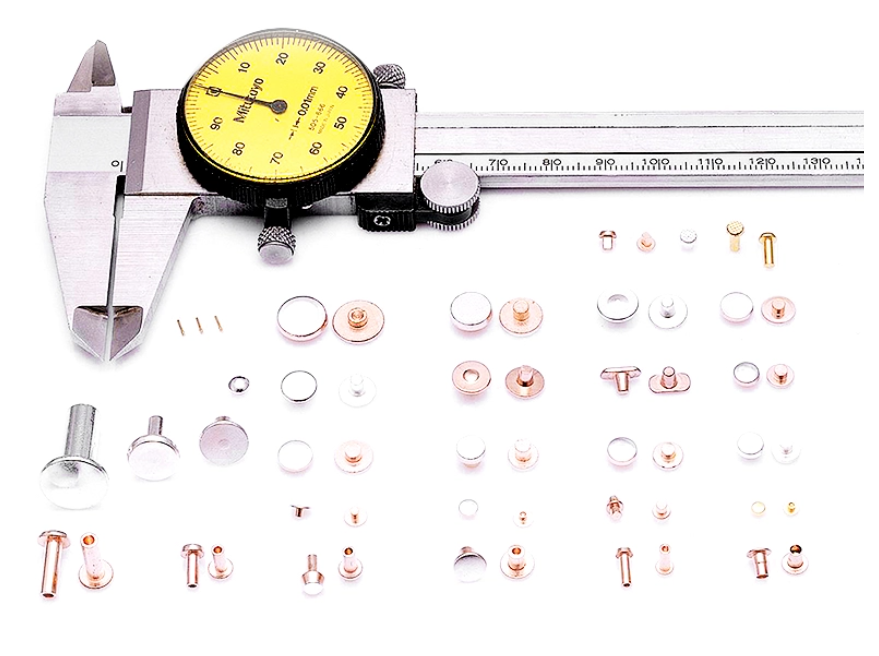
The standard electrical contact rivet sees widespread use across industrial and consumer goods. You will find them inside heavy-duty relays, wall switches, and HVAC thermostats. Solid copper rivets offer maximum current flow. Bimetal variants provide a clever hybrid approach. They utilize a thick copper core to handle bulk conductivity. Manufacturers then apply a precious metal facing. This facing absorbs the physical impact of continuous mating cycles.
Printed circuit boards (PCBs) require secure physical mounting points. A tubular rivet made of copper perfectly fits this requirement. Electronics manufacturers frequently utilize these hollow fasteners in complex PCB applications. They also appear in high-current terminal blocks. The tubular design allows for rapid automated clinching. They provide both electrical continuity and a robust mechanical anchor.
Many modern devices have strict spatial constraints. A rigid rivet cannot fit everywhere. In these cases, a profiled strip contact offers the necessary flexibility. Factories stamp these components from continuous rolls of rolled copper. This configuration represents the standard approach for complex multi-pin connectors. Micro-switches and edge connectors also rely heavily on strip forms. Engineers dictate specific spring characteristics into the stamped profile, ensuring reliable tension during component mating.
While pure copper offers maximum electrical efficiency, it lacks mechanical stiffness. Pure copper scratches and bends easily under continuous physical stress. Engineers solve this problem by introducing alloys and composite structures.
Oxygen-Free Copper (OFC) and Electrolytic Tough Pitch (ETP) represent the purest industrial forms. They deliver maximum potential conductivity. You should use pure copper in sealed environments. It works best where mechanical wear remains minimal. Common applications include internal power busbars and static, unmoving connectors.
Alloying copper sacrifices a portion of its raw conductivity. However, it delivers massive gains in physical durability.
Brass (Copper-Zinc): Highly machinable and inexpensive. It works well for standard plug terminals.
Phosphor Bronze: Offers excellent fatigue resistance. It maintains spring retention over thousands of cycles.
Beryllium Copper: Provides massive tensile strength. It acts almost like steel while remaining highly conductive. It is ideal for frequently mated, miniaturized connectors.
Manufacturers actively combat copper's primary weakness: surface oxidation. They treat bare copper as a robust base substrate. They then apply advanced surface treatments. For example, a factory might seamlessly integrate a silver alloy wire into the contact facing. Alternatively, they electroplate the copper core using tin, nickel, or gold. These hybrid solutions drastically lower surface contact resistance. Meanwhile, the thick copper core continues to provide superior thermal dissipation benefits.
Sourcing and deploying copper components involves distinct operational risks. You must navigate environmental hazards and strict manufacturing tolerances. Careful procurement planning prevents catastrophic downstream failures.
Bare copper reacts actively with atmospheric oxygen. It eventually forms a layer of copper oxide. Unfortunately, copper oxide functions as a semiconductor. It severely increases electrical contact resistance. If left unchecked, this resistance causes overheating.
Mitigation Strategy: You must carefully evaluate the operating environment. Specify appropriate plating materials for exposed contacts. Alternatively, implement a "wiping-action" design. Wiping contacts physically scrape away the oxide layer each time they mate.
Copper is malleable. Tooling machines cold-head or stamp millions of units continuously. Over time, the physical stamping tools wear down. This wear leads to microscopic dimensional variances in the finished parts. Even a tiny variance causes loose connections.
Actionable Step: Require strict Cpk (Process Capability Index) data from your suppliers. This statistical data proves they can maintain tight tolerances across massive production batches.
Global environmental laws strictly regulate metal manufacturing. Historically, foundries added lead or beryllium to copper to improve machinability. Modern regulations restrict these additives.
Actionable Step: Ensure all selected copper alloys strictly adhere to current RoHS and REACH directives. You must also verify conflict-mineral regulations to maintain ethical supply chains.
Do not treat electrical contacts as generic commodities. You must evaluate vendors thoroughly.
Traceability: Can they trace the raw copper back to the original foundry?
In-house Tooling: Do they build their own stamping dies to control precision?
Quality Testing: Ask for specific test reports. Reliable suppliers conduct in-house salt spray testing and conductivity verification continuously.
Best Practices | Common Mistakes |
|---|---|
Specifying wiping-action designs for bare copper contacts. | Using unplated copper in high-humidity or marine environments. |
Requesting material data sheets prior to bulk orders. | Assuming all "brass" alloys share identical spring properties. |
Matching the alloy's tensile strength to the expected mating cycle life. | Ignoring Cpk tooling data during vendor selection. |
Copper electrical contacts remain the industry default for very practical reasons. They do not represent a flawless, indestructible material. Instead, they provide an unmatched balance of electrical efficiency, thermal safety, and manufacturing scalability. Their physical predictability allows engineers to design robust systems confidently.
Engineering and procurement teams must take deliberate next steps during the design phase. Map your specific load requirements and cycle-life expectations meticulously. Compare these metrics against the available copper alloys and physical form factors. Request formal material data sheets from prospective vendors. Finally, acquire prototype samples for rigorous bench testing. Physical testing remains the most reliable method for validating your contact selection.
A: Copper has roughly 60% higher conductivity than aluminum by volume. It doesn't suffer from the same severe thermal expansion issues. Furthermore, copper does not form a highly resistive oxide layer as rapidly as aluminum. This stability makes copper much safer for physical contact points.
A: Pure copper is soft. If your application requires spring properties (like a tactile switch) or high mechanical durability, it will deform. Alloys like phosphor bronze or beryllium copper are required to prevent deformation while retaining adequate conductivity.
A: Silver has the highest electrical conductivity of all metals. Plating copper with silver (or utilizing a silver alloy facing) provides an oxidation-resistant, highly conductive mating surface. The part continues relying on the thicker copper base for structural integrity and heat dissipation.