Views: 0 Author: Site Editor Publish Time: 2026-06-24 Origin: Site
Component-level failure poses a critical systemic risk in global power distribution grids. A single degraded contact quickly triggers unscheduled downtime. It unleashes severe arc flash hazards and causes catastrophic equipment damage. Historically, engineers faced a frustrating dilemma. Traditional monometal contacts force a dangerous compromise. You must choose between high electrical conductivity and necessary mechanical wear resistance. Solid metals simply cannot handle modern loads alone.
Advanced circuit breaker clad metals eliminate this dangerous compromise entirely. They metallurgically bond specialized metals into a unified structure. This innovation directly reduces severe contact welding risks during short circuits. It improves thermal management dramatically across the entire switchgear assembly. Furthermore, this engineering choice ensures predictable decision-stage safety compliance. Facility operators and OEMs rely on this predictability to safeguard lives and protect critical infrastructure investments.
Thermal Superiority: Clad metals rapidly dissipate heat during high-current events, preventing thermal runaway.
Arc Erosion Resistance: Composite structures resist contact welding and material transfer better than solid alloys.
Lifecycle Predictability: Engineered cladding ensures consistent millivolt drop over the breaker’s lifespan, vital for safety-critical infrastructure.
Sourcing Advantage: Specifying precise clad profiles lowers operational expenses by reducing maintenance intervals and premature failures.
High-load switching creates violent, destructive internal environments. During a fault, arc plasma generates intense heat reaching thousands of degrees. Components must survive this extreme stress instantly. Breakers open to interrupt massive currents. The air gap between contacts ionizes immediately. This forms a superheated electrical arc. The arc violently attacks the contact surface. It vaporizes standard metals in milliseconds. Managing this intense thermal energy fundamentally defines electrical safety.
Solid metals fail to provide comprehensive protection here. Solid silver conducts electricity beautifully. However, it remains too soft. It wears down rapidly under repeated mechanical impacts. Conversely, solid copper offers excellent structural strength. Yet, copper oxidizes quickly under continuous load. This oxidation creates high contact resistance over time. High resistance generates even more heat. Neither metal works perfectly on its own. Engineers need a hybrid approach.
Material degradation creates a clear, dangerous failure pathway. Repeated arcing melts the contact surfaces slightly during each cycle. This repeated melting leads directly to contact welding. If contacts fuse together, the breaker fails to open. Equipment downstream faces catastrophic overload. The grid remains totally unprotected. Furthermore, ongoing high resistance generates excessive temperature rise. This slow heat buildup degrades surrounding insulation. It sets the stage for deadly electrical fires. We must break this degradation cycle entirely.
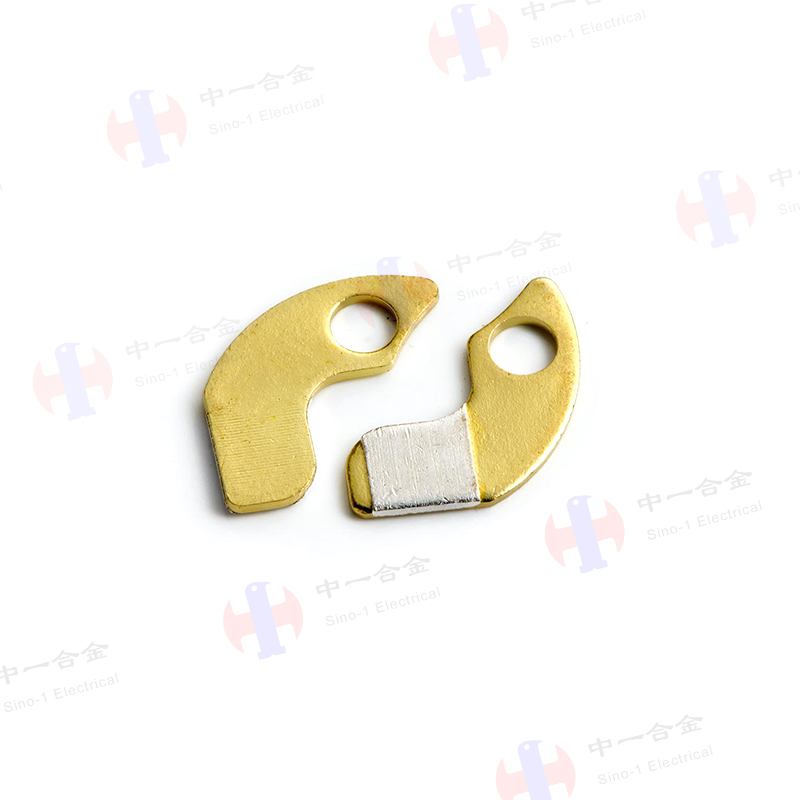
A composite bi-metal contact fundamentally solves these severe thermal challenges. Manufacturers use cold roll bonding or inlay processes to merge different metals. They pair a highly conductive face, like a silver alloy, with a sturdy backing. They typically use copper or brass for this foundation. This creates a permanent, secure metallurgical bond. The metals function as a single unit. They share their best properties without compromising mechanical integrity.
The backing material acts as a massive thermal sponge. It rapidly draws intense heat away from the arcing interface. This rapid thermal wicking prevents localized surface melting. Heat dissipates into the larger breaker body safely. Copper conducts heat exceptionally well. When paired with silver, it pulls the thermal load downward immediately. This mechanism keeps the critical contact face solid. It prevents the silver from reaching its boiling point during a fault.
Specific cladding ratios mitigate material transfer effectively. During the make-and-break cycle, the silver alloy face resists sticking. The precise pairing prevents contacts from fusing during short circuits. Breakers trip reliably exactly when needed. You avoid dangerous welded contacts entirely. We balance anti-welding properties with low contact resistance. Cadmium-free silver metal oxides often serve this exact purpose well. They meet strict environmental standards while providing robust arc protection.
Metallurgical bonds ensure superior mechanical integrity. Traditional brazed contacts often contain hidden micro-voids. These tiny gaps create dangerous hotspots under heavy electrical load. Cladding completely eliminates these structural weaknesses. It guarantees uniform current flow across the entire contact surface. The atomic-level bond resists delamination. It withstands the violent mechanical shock of modern fast-acting breakers. You gain absolute structural confidence.
Engineers must look strictly beyond basic marketing claims. You should evaluate specific performance metrics carefully. Demand rigorous bond shear strength figures from your suppliers. Check conductivity percentages for the finished composite material. You should also request comprehensive ultrasonic testing results. These scans detect any internal voids before final installation. High-quality breaker contact assemblies always pass these strict quality gates. They leave absolutely nothing to chance.
Dimensional accuracy matters immensely in power distribution. We rely on precision clad metal stamping parts to maintain correct mechanical alignments. Proper stamping guarantees optimal contact pressure during every operation. Poorly stamped components cause uneven wear patterns. These inaccuracies quickly escalate into severe safety risks. Precision manufacturing ensures long-term operational stability. Even minor dimensional deviations increase contact resistance dangerously.
Compliance testing remains entirely non-negotiable. Always demand UL 489 or IEC 60947 compliance testing data. Reliable suppliers provide comprehensive lifecycle testing reports. They simulate actual load conditions rather than citing theoretical material properties. You need empirical evidence proving safety under extreme duress.
Material Approach | Thermal Dissipation | Arc Erosion Resistance | Welding Risk | Safety Predictability |
|---|---|---|---|---|
Solid Silver | Excellent | Poor | High | Low (Rapid Wear) |
Solid Copper | Good | Moderate | Moderate | Low (Oxidation) |
Brazed Composite | Variable (Void Risk) | Good | Low | Moderate |
Engineered Clad Metal | Excellent | Excellent | Very Low | Very High |
Internal metal reliability strictly dictates overall system safety. You cannot build safe switchgear using subpar internal contacts. Every sub-component must function flawlessly together. The electrical integrity directly translates to physical safety for facility personnel. When the internal heart of the breaker stays cool, the surrounding enclosures remain safe to handle.
Reliable contacts actively support vital "Five Prevention" safety standards. These mechanical and electrical interlock systems prevent deadly human operator errors. They block operators from engaging disconnect switches under load. They stop personnel from opening live compartments. If a contact fuses or develops high resistance, sensors misread the breaker status. The interlock might falsely allow an operator to open a live, energized cabinet. High-quality clad metals prevent these dangerous misfires entirely. They ensure the interlock mechanisms always receive accurate physical feedback.
Predictable wear rates transform modern facility management. Maintenance teams can rely on scheduled service intervals confidently. They stop reacting blindly to unexpected thermal alarms or sudden catastrophic failures. Consistent material degradation allows for highly accurate lifecycle planning. You replace parts based on known timelines, not ongoing emergencies.
Implement regular thermographic inspections to monitor enclosure temperature baselines.
Verify contact millivolt drops annually to track cladding wear progression accurately.
Ensure mechanical interlock sensors align perfectly with contact stroke lengths.
Maintain comprehensive logs of fault clearing events to predict component exhaustion.
Assembly methods heavily influence final product longevity. Using an electrical contact rivet often outperforms traditional brazing. Riveting offers a remarkably clean, heat-free assembly process. It works exceptionally well for specific control relays and low-voltage designs. By avoiding intense heat during assembly, you preserve the exact temper of the base metal. Brazing heat can soften critical copper supports unintentionally. Cold-headed rivets avoid this thermal degradation completely.
Supply chain consistency poses a constant, daily challenge. Lower-tier suppliers sometimes substitute base materials quietly. They might reduce the precious metal cladding thickness to cut their margins. You must monitor incoming batches stringently. Inconsistent silver thickness leads directly to premature arcing failure. Establishing strong, transparent vendor relationships mitigates this significant risk. You must demand batch-specific metallurgical certifications upon delivery.
We must weigh initial engineering costs against comprehensive safety returns. Engineered clad metals carry higher upfront engineering expenses than simple alloys. The complex roll-bonding process requires significant capital equipment. However, this initial investment delivers a massive commercial advantage later. It drastically reduces expensive field warranty claims. More importantly, it prevents catastrophic safety failures that trigger legal liabilities. The initial premium pays for itself through uncompromised operational reliability. You secure total peace of mind alongside grid stability.
Accepting generic "silver alloy" specs without asking for precise composition percentages.
Ignoring the base metal temper requirements for spring-loaded contact arms.
Failing to specify minimum bond strength requirements on your purchase orders.
Overlooking the importance of edge-condition specifications for stamped parts.
Specifying advanced clad materials represents a fundamental safety decision. It stands far above a simple spreadsheet procurement line item. These engineered composites handle immense thermal stress dynamically. They prevent deadly arcing faults effectively. They keep your essential power networks running without dangerous interruptions.
Buyers must audit their current supply chains actively. We advise evaluating your vendor's specific metallurgical capabilities deeply. Review their internal quality control data thoroughly. Examine their non-destructive testing protocols closely. Ensure they meet the highest global safety standards consistently. Never accept mere verbal assurances for safety-critical components.
Protect your critical power infrastructure today. Consult with application engineering teams to evaluate your specific voltage and current requirements. Request custom material samples for your internal lab testing. Ask for technical whitepapers to verify performance claims firsthand. Take proactive steps to engineer failures completely out of your electrical systems.
A: The key differences lie in thickness and structural durability. Plating is a micro-thin surface layer that wears off quickly under harsh arcing conditions. Cladding involves a deep, structural, and permanent metallurgical bond. Engineers design clad metals specifically for heavy mechanical impact and long-term electrical wear.
A: Clad stamping allows engineers to create custom cross-sections. They concentrate the highly conductive and thermal-wicking materials exactly where heat generates. This strategic placement optimizes heat dissipation. Consequently, it significantly improves the overall thermal rating and current-carrying capacity of the entire circuit breaker.
A: Rivets have strict application limits based on fault currents. They are highly reliable for low-to-medium voltage environments and specific control relays. However, larger medium-to-high voltage switchgear systems handle massive physical forces. These high-voltage applications usually require heavier brazed assemblies or directly stamped robust configurations.
A: You should demand strict testing documentation from your supplier. Industry-standard verification includes non-destructive testing, such as ultrasonic scanning, to find hidden voids. It also involves destructive testing, like bond shear and bend tests. Reputable manufacturers always provide these results on their official Certificates of Analysis (CoA).