Views: 0 Author: Site Editor Publish Time: 2026-07-29 Origin: Site
Electrical contact design forces engineers to balance maximum electrical conductivity against the mechanical and thermal durability required for high-cycle switching. Incorrect metallurgical compositions lead to premature arc erosion, unacceptable temperature rises, increased contact resistance, or catastrophic device failure in electromagnetic contactors and relays. Specifying the correct material properties prevents these operational hazards and ensures long-term reliability under electrical load. Silver-Nickel (AgNi) composites serve as the industry-standard solution for medium-to-heavy load applications. Within these composites, the specific percentage of nickel acts as the critical variable that engineers must evaluate to optimize component lifespan and performance. Understanding how nickel content alters the physical and electrical properties of the contact is essential for selecting the appropriate grade for any given switching environment.
Arc Erosion vs. Conductivity Trade-off: Increasing nickel content directly improves resistance to arc erosion and mechanical wear, but inherently increases contact resistance.
Microstructure Matters: The performance of silver nickel contact wire is dictated not just by the nickel percentage, but by the uniform dispersion of nickel particles within the silver matrix.
Application-Specific Thresholds: Excessive nickel can lead to rapid contact degradation due to oxidation and thermal buildup; specifying the exact AgNi ratio (e.g., AgNi10, AgNi20) requires precise load, cycle, and environmental profiling.
Form Factor Flexibility: While wire is standard for many rivets and contacts, transitioning to a silver alloy strip or silver alloy sheet may be necessary depending on the manufacturing process and thermal dissipation requirements.
Film Breakdown Requirements: High-nickel contacts require sufficient mechanical wipe or arc energy to break down surface oxide and salt films to prevent high-resistance failures.
Electrical contacts must meet strict baseline requirements to function effectively in power switching applications. These success criteria include maintaining low contact resistance to prevent overheating, demonstrating high resistance to contact welding during current surges, and exhibiting low material transfer between mating surfaces. Achieving all three simultaneously requires a material that can conduct electricity efficiently while withstanding intense localized heat and physical impact. Engineers rely on silver alloy materials to solve these complex electromechanical challenges.
Fine silver offers exceptional electrical and thermal conductivity. It acts as an ideal conductor in theory. However, pure silver fails rapidly in high-load switching environments. It is highly susceptible to mechanical wear and deforms easily under the repetitive impact of contact closure. Pure silver suffers from severe arc erosion and contact welding when subjected to electrical arcing. Its low melting point allows the surface material to liquefy and fuse during operation, causing the relay or switch to stick in the closed position.
To overcome these limitations, engineers utilize Silver-Nickel (AgNi) composites. In this structure, nickel acts as a refractory phase distributed throughout the highly conductive silver matrix. Silver and nickel do not form a true solid solution because they are mutually insoluble in both liquid and solid states. AgNi is technically a pseudo-alloy or composite material. The dispersed nickel particles provide mechanical reinforcement. They raise the hardness of the material and significantly improve its ability to resist the destructive forces of electrical arcing without completely sacrificing the conductivity of the silver.
Nickel fundamentally alters how the contact surface responds to the intense thermal energy generated by an electrical arc. As the arc strikes the contact, the nickel particles absorb a significant portion of the arc energy. This prevents the surrounding silver matrix from vaporizing instantly. This refractory behavior stabilizes the contact surface and limits the depth of the melt pool. Increasing the nickel content from 10% to 20% or even 30% measurably extends the lifecycle of the contact. This is particularly true when switching inductive or capacitive loads that generate severe arcing.
Material Grade | Nickel Content (%) | Conductivity (% IACS) | Arc Erosion Resistance | Typical Application |
|---|---|---|---|---|
Fine Silver | 0% | 100% | Very Low | Low current, signal relays |
AgNi10 | 10% | 85 - 90% | Moderate | Appliance switches, 10A-20A relays |
AgNi20 | 20% | 70 - 75% | High | Motor contactors, heavy-duty switches |
AgNi30 | 30% | 60 - 65% | Very High | High-inrush industrial breakers |
Beyond thermal protection, nickel hardens the composite matrix. This increased hardness reduces physical deformation, commonly referred to as mushrooming. Mushrooming occurs during millions of mechanical make-and-break cycles. A harder contact maintains its original geometry longer, ensuring consistent contact pressure and alignment. The presence of nickel mitigates material transfer between the anode and cathode in direct current (DC) applications. By anchoring the silver, nickel restricts the formation of pip and crater defects. These defects otherwise lead to mechanical interlocking and premature device failure.
While adding nickel improves wear resistance, engineers must account for the diminishing returns of high nickel content. Pushing the nickel percentage too high creates a brittle matrix. This brittle material is difficult to manufacture and prone to cracking under mechanical shock. Excessive nickel creates a surface highly susceptible to high-resistance nickel oxide formation. When these oxides accumulate faster than they can be cleared by mechanical wiping, the contact resistance spikes. This ultimately causes thermal failure and destroys the switching device.
The primary engineering challenge when specifying these composites is managing the inverse relationship between nickel percentage and electrical conductivity. Conductivity is measured in % IACS (International Annealed Copper Standard). As nickel content rises to improve wear resistance, the overall conductivity of the material drops proportionally. Engineers must establish a precise decision framework to calculate the maximum allowable contact resistance for a specific device. Exceeding this threshold limits current flow and generates excessive localized heat. This turns a durable contact into a thermal runaway risk.
Operating environments heavily influence the performance of nickel-bearing contacts. In high-humidity or corrosive atmospheres, oxides and nickel salts rapidly form on the contact surface. These insulating films block current flow. They must be managed through mechanical, electrical, and thermal self-cleaning mechanisms. Effective device design incorporates mechanical contact wiping action, high-force spring tension, and sufficient arc energy to pierce or vaporize these surface films during each switching cycle. This ensures a clean metal-to-metal connection.
The increased contact resistance inherent to higher-nickel alloys directly affects the steady-state temperature of the switching device. As the contacts heat up during continuous current conduction, the surrounding components endure higher thermal stress. Mitigation strategies are essential to maintain safe operating temperatures. Engineers optimize contact pressure to maximize the effective conductive area. They frequently utilize highly conductive backing materials, such as copper alloys, to act as heat sinks. These heat sinks rapidly draw thermal energy away from the contact interface.
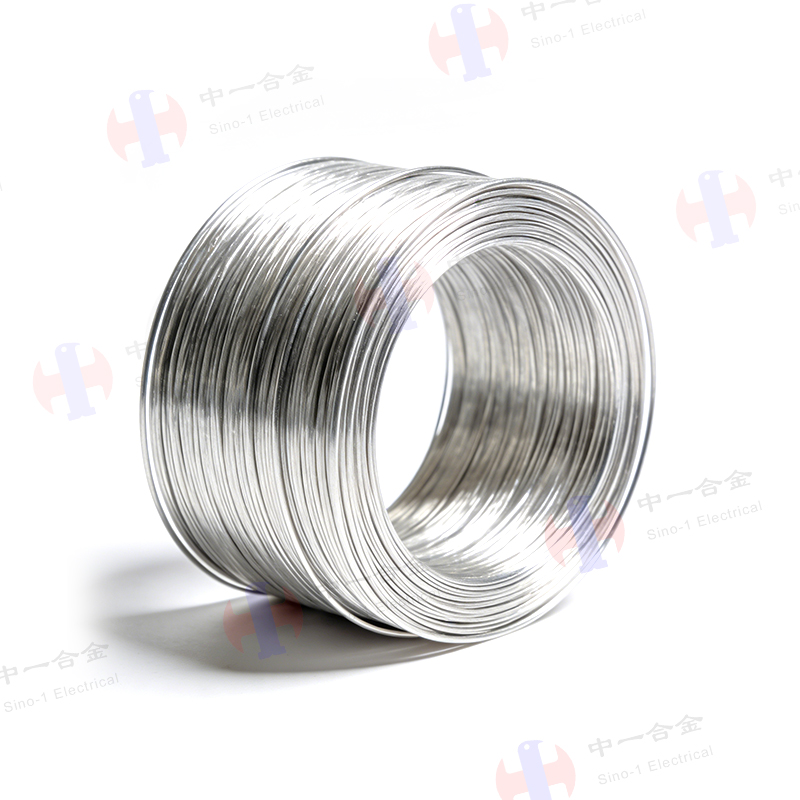
Manufacturing solid or bimetal contact rivets typically relies on silver nickel contact wire fed into high-speed cold-heading machines. The wire drawing process involves significant cold-working. This increases the tensile strength and hardness of the material. During these severe deformation stages, the nickel content plays a vital role in stabilizing the composite microstructure. The dispersed nickel prevents the silver matrix from shearing unevenly. This ensures the final rivet maintains structural integrity and consistent electrical properties throughout its volume.
While wire is standard for rivets, certain applications require transitioning to a silver alloy strip. Stamping contacts directly from a strip proves highly cost-effective and technically viable when producing complex terminal shapes or running continuous progressive stamping operations. For heavy-duty circuit breakers managing massive current loads, engineers specify a silver alloy sheet to create large-area contact pads. The sheet format provides the necessary thermal mass, facilitates even current distribution across a wider surface area, and maximizes heat dissipation to prevent localized melting during short-circuit events.
Because silver and nickel are mutually insoluble in a liquid state, traditional melting and casting processes cannot produce a uniform AgNi alloy. Manufacturers rely on advanced powder metallurgy. This approach involves blending fine silver and nickel powders, compacting them under extreme pressure, and sintering the billets below the melting point of silver. The sintered material is then extruded and drawn or rolled into its final form. This powder metallurgical process is strictly required to achieve the precise microstructural dispersion necessary for reliable electrical performance.
The quality of the manufacturing process directly dictates field reliability. Poor manufacturing leads to agglomerated, or clumped, nickel particles within the silver matrix. This poor dispersion creates zones of pure silver and zones of pure nickel. It results in uneven wear, localized heating, and premature contact failure. Well-dispersed fine nickel particles ensure uniform electrical conductivity across the contact face. They optimize arc erosion resistance, allowing the material to wear evenly over millions of cycles.
Engineers must differentiate true composite materials from silver-plated nickel alternatives. A true composite provides deep, volumetric wear resistance. The material properties remain consistent even as the contact surface erodes. Silver-plated nickel wire relies entirely on a thin surface barrier to prevent moisture and corrosive elements from affecting the underlying nickel core. Under electrical arcing, this plating barrier is quickly worn away or vaporized. Once breached, the pure nickel core is exposed to rapid oxidation, thermal failure, and severe corrosion. This makes plated materials entirely unsuitable for arcing contact applications.
Procuring the correct contact material requires buyers to document their exact application parameters thoroughly. Specifications must detail the load type, including whether the device switches alternating current (AC) or direct current (DC). You must define whether the load is resistive, inductive, or capacitive. Engineers must define the expected inrush current, steady-state current, required cycle life, and the operating environment. Pay special attention to ambient humidity and the presence of corrosive agents that could accelerate surface film formation.
Document the exact electrical load profile, including peak inrush and steady-state currents.
Determine the mechanical wiping force available in the switch design to clear oxides.
Calculate the maximum allowable voltage drop across the closed contacts.
Assess the environmental conditions, specifically humidity and ambient temperature.
Select the initial AgNi ratio based on the balance of arc erosion and conductivity needs.
Evaluating material selection requires a comprehensive lifecycle cost analysis. Specifying a higher nickel content may increase initial material costs. It can accelerate tooling wear during the cold-heading or stamping manufacturing processes due to the increased hardness of the composite. This upfront investment significantly enhances the durability of the contact. It directly reduces warranty claims, prevents costly field failures, and extends the operational lifespan of the final switching device.
Procurement teams must enforce strict quality assurance standards to guarantee material reliability. Suppliers should provide comprehensive material testing reports with every batch. Essential documentation includes micrographic analysis verifying the uniform dispersion of nickel particles. You need conductivity testing to ensure the material meets the specified % IACS rating. Request environmental exposure tests confirming the material's resistance to oxidation. Verifying these metrics ensures the supplied material complies with engineering specifications and will perform safely under load.
Audit your current contact failure modes to determine if arc erosion, mechanical wear, or thermal runaway is the primary issue.
Consult with a metallurgical engineer to specify the exact AgNi ratio based on your specific electrical load profile and mechanical wipe capabilities.
Request material data sheets and micrographic analysis from your supplier to verify uniform nickel dispersion.
Order sample materials for prototype life-cycle testing within your actual device architecture.
A: Standard grades typically include AgNi10, AgNi15, and AgNi20. AgNi10 is used for moderate loads requiring low contact resistance. AgNi15 offers a balanced middle ground. AgNi20 is specified for heavy-duty applications where maximum arc erosion resistance is required, provided the device has sufficient mechanical wipe to clear surface oxides.
A: Yes, nickel acts as a mechanical reinforcement within the silver matrix. Increasing the nickel percentage raises the overall hardness of the composite. This hardening effect improves resistance to physical deformation during operation but also increases the force required for cold-heading and stamping during manufacturing.
A: There is an inverse relationship between nickel content and electrical conductivity. As the percentage of nickel increases to improve wear resistance, the material's overall conductivity decreases. Engineers must balance this to prevent excessive contact resistance and localized heating.
A: Silver nickel contact wire is a volumetric composite where nickel is dispersed throughout the silver, providing consistent wear resistance as the contact erodes. Silver-plated nickel wire only has a thin conductive surface layer. Once an electrical arc vaporizes this plating, the pure nickel core oxidizes rapidly, leading to failure.
A: Silver and nickel are mutually insoluble in a liquid state, meaning they will not mix properly if melted together. Powder metallurgy involves blending, compacting, and sintering fine powders below the melting point. This process is required to achieve the uniform dispersion of nickel particles necessary for reliable electrical performance.
A: Yes, depending on the manufacturing process. Wire is used for cold-heading solid rivets. Silver alloy strip is ideal for progressive stamping processes to create complex terminal shapes or integrated contact arms. It often proves more efficient for high-volume production of specific geometries.
A: High humidity and corrosive environments accelerate the formation of insulating nickel salts and oxides on the contact surface. If not managed, these films cause contact resistance to spike. Devices must utilize mechanical wiping action or rely on electrical arcing to break down these films during operation.